Cologne Bonn Airport Departures: two terminals, one time-slot system, round the clock
Cologne Bonn is one of the few German airports with no night flight curfew — and it runs a security time-slot system that is more generous than most. Knowing both makes for a calmer departure.

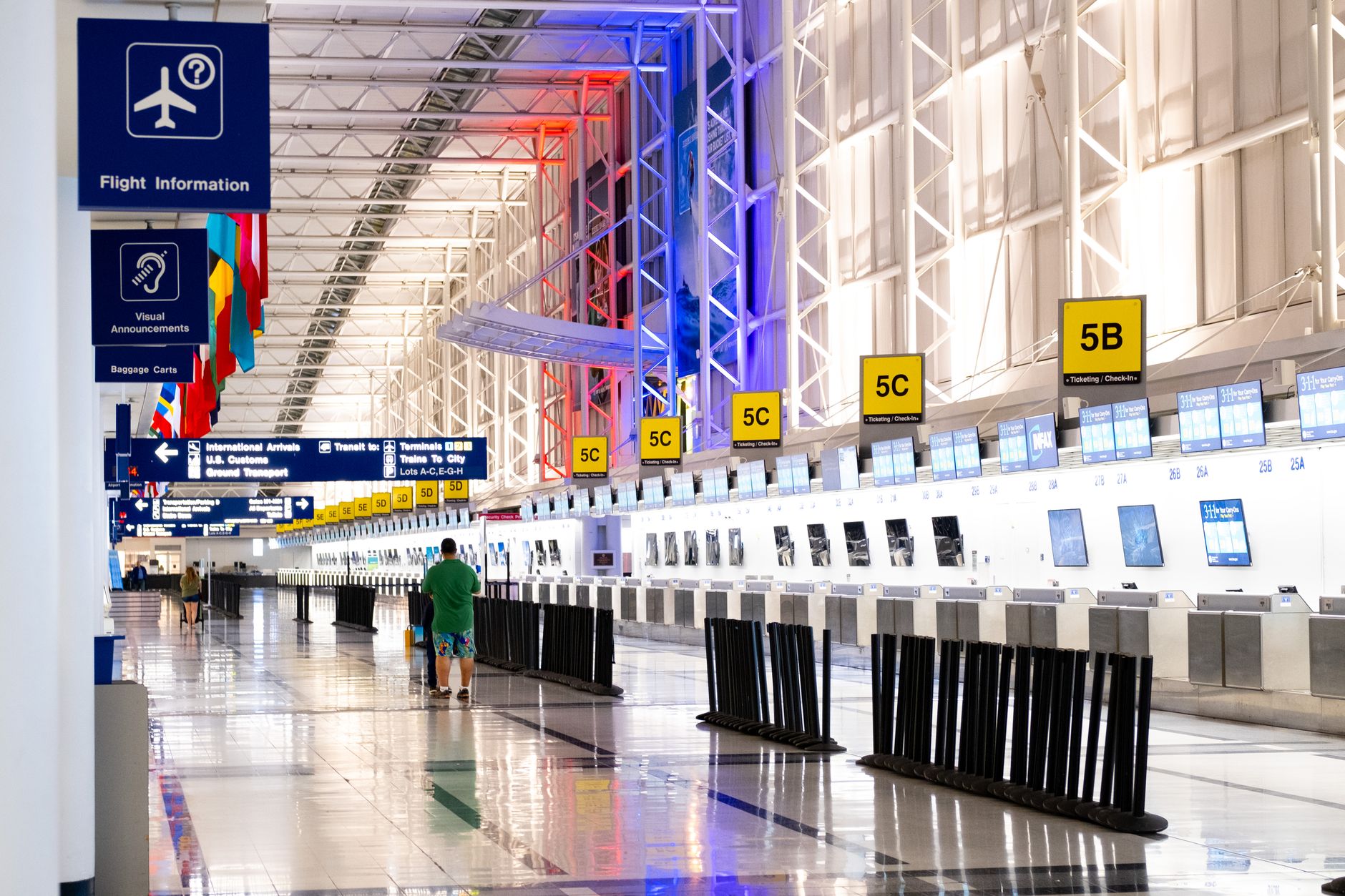
Cologne Bonn has something of a split personality, and that’s not just a figure of speech: two terminals built three decades apart, two distinct groups of airlines, two genuinely different routes through the building depending on who you’re flying with. Know this before you set off and you won’t waste time hunting for the right door on departure morning.
There’s a second thing that sets CGN apart from most German airports: there’s no night flight curfew here. While things fall quiet after a certain hour in Stuttgart, Frankfurt or Munich, cargo aircraft — and occasionally passenger flights — still take off along the Rhine at three in the morning. More on what that means for your planning further down. First, the question that matters more for most travellers: your terminal.
Two terminals, two worlds: who checks in where
Terminal 1 is the original: opened in 1970, designed by architect Paul Schneider-Esleben, a pentagonal concrete building with two star-shaped satellite piers, B and C. Ten of the stands there have a jet bridge; three more are reached on foot across the apron. This is where you check in if you’re flying with a Lufthansa Group carrier — Lufthansa, Austrian Airlines or Eurowings. Cologne Bonn is one of Eurowings’ larger bases (as of 2026), and the airline’s presence shapes Terminal 1 accordingly: most of the counters and signage there are geared towards it.
Terminal 2 is thirty years younger and looks it. Opened in June 2000, designed by architect Helmut Jahn, a glass-and-steel hall with eight gates and around 40 check-in counters, built to handle up to six million passengers a year. This is Ryanair’s home — by some distance the largest single airline at Cologne Bonn — along with most of the other low-cost and leisure carriers: Wizz Air, Condor, TUI fly, Corendon and, depending on the season, further charter operators.
The two buildings are connected landside, meaning before security — a covered walkway, not a shuttle or a train. Which also means: once you’re checked in and through security, you’re committed to that terminal. Switching afterwards isn’t straightforward. So work out which terminal your airline uses before you set off rather than orienting yourself on arrival — with two buildings this different, a wrong guess costs more time here than at most airports.
Check-in and Self Bag Drop
Online check-in is available with virtually every airline flying from Cologne Bonn, so your boarding pass is sorted from home, on your phone or printed out. If you’re checking a bag, you’ll still pass a counter or a machine, and the airport has set up a separate system for the big airline groups.
In Check-in Area 100 in Terminal 1, Self Bag Drop machines serve the Lufthansa Group — Lufthansa, Eurowings and Austrian Airlines. You check in online, print or scan your bag tag at the machine, attach it yourself and drop the bag on the belt without queuing at a staffed counter. Check-in Area 200 in Terminal 2 offers the same for Ryanair.
One restriction is worth knowing before you join the wrong queue: oversized luggage, pushchairs, rucksacks and special baggage can’t go through the machines — those need a staffed counter. How early counters open before departure is set by each airline individually, typically two to three hours out, but there’s no single rule across the airport. If you’ve got a very early flight, check your airline’s own site so you don’t end up in front of a still-closed desk. For how airlines actually differ on carry-on sizing, and what really counts as free hand luggage, see Hand Luggage Sizes by Airline — worth checking especially for Terminal 2, where gate staff tend to measure bags more strictly than the Lufthansa Group carriers next door.
CGN Gateway: your security time slot
Something many travellers don’t know, despite it having existed for years: Cologne Bonn lets you book your security check in advance, free of charge, through a system called CGN Gateway. You reserve a fifteen-minute slot online — from up to 100 days out down to one hour before departure, subject to availability — and get a dedicated lane at the central checkpoint in the middle of Terminal 1, with roughly ten minutes’ tolerance either side of your booked time.
That’s more generous than comparable systems at other German airports. At Stuttgart, for instance, a similar time slot can only be booked 72 hours before departure; at Cologne Bonn you get the best part of three months’ notice. For travellers who plan well ahead — families booking a holiday flight, business travellers with a fixed appointment — that’s a genuine difference: you can sort the slot the moment you book the flight instead of setting yourself a reminder weeks later.
Worth noting for context: the Gateway system is tied to the central checkpoint in Terminal 1. If you’re flying Ryanair or another Terminal 2 airline, your security check runs through that terminal’s own checkpoint inside the building — no online time slot there, but shorter distances overall, since Terminal 2 is more compact than Terminal 1.
As everywhere, a booked slot isn’t a fast lane past other passengers — it spreads demand across the day. Miss your slot and you join the normal queue. The benefit is knowing exactly when your turn comes, rather than gambling on an unknown queue at an unknown time.
How much time you actually need
Unlike some other German airports, Cologne Bonn doesn’t publish a fixed arrival time on its website. The rule of thumb that holds up in practice at an airport this size: at least two hours before departure if you’re checking a bag and flying within Europe, more like three hours if your destination is outside the EU or Schengen area and you need to allow for passport control. Travelling with hand luggage only and already checked in online, 90 minutes to security is usually enough, provided you haven’t picked the start of school holidays or the busiest hour of the day.
Two things shift that maths in practice. First, anyone with a booked CGN Gateway slot can strip almost all the uncertainty out of the security portion of the day — what’s left is the walk to the gate afterwards, and that’s shorter in Terminal 2 than in Terminal 1, since the building is smaller and its eight gates sit closer to the checkpoint. Second, anyone checking a bag from Terminal 1 should factor in the Self Bag Drop machines in Check-in Area 100 — faster than a staffed counter, but only if the bag isn’t oversized or carrying special equipment.
Border checks have become an extra time factor for flights outside the Schengen area, such as to the UK, since the phased rollout of the EU’s Entry/Exit System (EES). If that applies to you, budget the extra time at border control specifically, not just at security — the two queues run independently of each other.
The airport that never really closes: 24-hour operations
The second big difference from almost every other commercial airport in Germany has nothing to do with your terminal and everything to do with the clock: Cologne Bonn is one of the few German airports with no night flight curfew, and it runs round the clock. Stuttgart, Munich and Frankfurt all enforce a quiet period overnight during which scheduled passenger flights are suspended or heavily restricted. Not here.
The main reason is cargo, not passengers. Cologne Bonn is Germany’s third-largest cargo airport (around 842,000 tonnes handled in 2025) and home to major overnight hub operations for FedEx Express and UPS Airlines — UPS alone runs roughly 140 flights a week from here. Those networks only work if freighters can take off and land at two or three in the morning, and that’s exactly what the airport permits.
For you as a passenger, that has one concrete side effect: because there’s no protected quiet period, leisure and low-cost carriers at Cologne Bonn occasionally schedule flight times that a curfewed airport simply couldn’t offer — very early departures just after midnight or late arrivals well past it, especially during peak holiday periods when aircraft and slots are tight. If you’ve booked a flight like that, it’s worth checking whether your route to the airport still works at that hour: trains and public transport run less frequently overnight, and not every car park is staffed around the clock, even though entry itself is always possible. If a taxi turns out to be the only option left, work it out in advance — how far Cologne Bonn actually is from your starting point, and what the fare looks like is not a trivial sum at three in the morning.
For the large majority of flights — the ones departing during the day or early evening — round-the-clock operations change nothing about your own routine. It’s still the reason Cologne Bonn occupies such an unusual place in the German airport system: an overnight hub for two of the world’s biggest logistics operators, sitting right next to an entirely ordinary passenger terminal.
Getting there: train, motorway and car parks
By train, you arrive more directly than the name “Cologne Bonn” might suggest: the airport has its own ICE station, in operation since 2004 and part of the Cologne–Rhine/Main high-speed line. From there it’s around 11 minutes to Cologne Hauptbahnhof and 8 minutes to Cologne Messe/Deutz, on ICE services that continue through to Frankfurt — about 47 minutes away. Regional lines RE6 and RB27, plus the S19 suburban service, fill in the rest of the network. The station sits directly beneath Terminal 2, a short walk from the check-in areas of both terminals.
By car, the A59 motorway has its own “Flughafen” exit leading straight in, backed up by the B8 — the airport is deliberately built on a “drive-in” principle, with short distances from the motorway exit to the car parks. In total there are more than 12,500 spaces across car parks P1 (around 1,120 spaces), P2 (around 4,022) and P3 (around 6,547), plus the surface-level Parkplatz Nord. Clearance in the multi-storey car parks is capped at 1.95 metres — with a roof box or a taller vehicle, check in advance which car park suits you, rather than finding out at the barrier. How that same clearance question plays out at an even bigger site is covered in the comparison with Munich, where the same rule applies across considerably more car parks.
Planning ahead pays off: pre-booked parking starts at around €39 a week (as of 2026), and on Sundays and public holidays, car parks P1 to P3 run a flat short-stay rate of €3 between 9am and 7pm. If you’re just dropping someone off or picking them up, that’s the cheapest window of the entire weekend.
What makes Cologne Bonn unusual among German airports, in the end, has less to do with size than with the particular combination of quirks: a terminal from the seventies standing next to one from the turn of the millennium, a free time-slot system with an unusually long booking window, and overnight operations that most other German sites simply aren’t allowed any more. For your own planning, that boils down to three things: work out your terminal before you set off, book your CGN Gateway slot as soon as you have your flight, and double-check your journey there if your departure falls at an unusually early or late hour — the airport itself has no problem with it, but your train connection might. All details reflect the situation as of 2026; terminal assignments and the terms of CGN Gateway are set by the airport and may change. Further airports are covered under The Airports.
Keep reading
Departure & Security
Departures at Stuttgart Airport: Four Terminals, One Booked Slot
Departing from Stuttgart Airport: which terminal, when you need to be there, and how to book a free time slot for the security check in advance.
Sophie Bauer14 August 2026
Departure & Security
Hamburg Airport Departures: two terminals, one security check, one slot
Departing Hamburg Airport: which airlines check in at Terminal 1 or 2, the central security checkpoint in the Airport Plaza, Slot & Fly, evening-before check-in and how much time to allow (as of 2026).
Sophie Bauer25 September 2026
Departure & Security
BER Airport Departures: Terminal 1 or 2, security without a slot, and a detour-prone journey
Departing Berlin BER in 2026: the three airlines that check in at Terminal 2, why Terminal 5 is gone, evening-before bag drop, CT scanners instead of BER Runway, the 2.5-hour rule and this autumn's rail engineering works.
Sophie Bauer25 September 2026
Departure & Security
Düsseldorf Airport Departures: one hall, three piers, three security checks
Departing Düsseldorf Airport: the central check-in hall, the checkpoints at piers A, B and C, DUSgateway, the SkyTrain from the long-distance station, the S11 and U80, and how much time to allow (as of 2026).
Sophie Bauer25 September 2026
Departure & Security
Munich Airport Departures: Terminal 2 for Star Alliance, Terminal 1 for Everyone Else
Departing Munich Airport: Terminal 2 belongs to Star Alliance, Terminal 1 to everyone else. The new pier, security checks and how much time you need (as of 2026).
Sophie Bauer9 July 2026