Dortmund Airport Arrivals: One Terminal, Two Ways Into Town
Dortmund has just a single, compact terminal, but there's no railway station at the airport itself — getting into town means choosing between a direct express bus and a train-and-shuttle combination.

Land in Frankfurt or Munich and you can spend a quarter of an hour just walking from the gate to baggage claim. Dortmund is a different story. The airport has a single terminal, nicknamed the “terminal of short distances”, built between 1998 and 2000 for up to 3.5 million passengers a year. In 2024 it handled around 3.13 million, and the airport is forecasting roughly 3.24 million for 2025 (as of 2026) — making Dortmund Germany’s eleventh-busiest airport and the third-largest in North Rhine-Westphalia, behind only Düsseldorf and Cologne/Bonn.
The airport sits around ten kilometres east of Dortmund city centre, right on the boundary with Holzwickede and Unna, with direct access to the B1 and, within a few minutes, the A1, A40 and A44 motorways. What sets it apart from bigger airports isn’t just its size, though: there’s no railway station at the airport itself. If you want to travel by train, you get off a few kilometres away and take a shuttle — a detail that makes the journey into town a little more of a planning exercise than at some other German airports.
One terminal, three levels
The terminal is organised across three levels, and the layout couldn’t be simpler: Level 0 is the arrivals level, with baggage claim and customs; Level 1 is departures, with 30 check-in desks and three security checkpoints (A, B and C); Level 2 is a gallery level with a visitor terrace. The airport has 13 aircraft stands in total — plenty for the current volume of traffic, so long waits for a free gate are rare.
Two exits lead out of the terminal: the west exit, near a designated smoking area, and the east exit, where the taxi rank is also located. The terminal itself is open from 3:30am to midnight — there’s no way to stay inside overnight if your connection isn’t until the next morning, so factor that in if you’re flying very early or landing late.
Baggage claim and customs
After landing, the route takes you straight down to Level 0. Three baggage carousels serve the arrivals area, with monitors showing which belt is handling which flight. At an airport this size — Hannover, by comparison, covers several times the floor area — the walk from gate to carousel is short, and on most flights the first suitcase appears within a few minutes of the aircraft docking.
Customs sits right beside baggage claim, with the usual two channels: green for travellers with nothing to declare, red for anything over the duty-free allowance or brought in from outside the EU. That rule is the same at every German airport, Dortmund included.
Passport control: only on a handful of routes
Because most of the schedule is made up of destinations inside the EU and the Schengen area — Hungary, Poland, Romania, Slovakia, Spain, Italy and similar — passport control simply doesn’t apply to most arriving passengers. You walk straight from the aircraft to baggage claim, with federal police carrying out spot checks at most.
Passport control only kicks in if your flight originates outside Schengen. In Dortmund’s case that means essentially two routes: Istanbul, flown by Pegasus and SunExpress, and London Luton, served by Wizz Air UK — both outside the Schengen area, the UK doubly so since Brexit. If you’re arriving on either of those, build in extra time before baggage claim, even though queues rarely run long given the aircraft sizes involved.
Who flies from Dortmund now
The airport’s route map has shifted noticeably in recent years. Ryanair, one of the defining names here for years, announced in October 2024 that it would pull out of Dortmund entirely, and flew its last routes out by summer 2025 — anyone who remembers the airport from its Ryanair years will find a rather different network today.
Wizz Air has stepped even further into that space, and has been the anchor carrier here for years. Between Wizz Air and Wizz Air UK, it links Dortmund to around forty destinations, weighted heavily towards Central, Eastern and South-Eastern Europe: Budapest, Bratislava, Warsaw, Belgrade, plus smaller points such as Târgu Mureș, Varna or Hévíz that cater largely to travellers with family ties in the region. Add to that holiday routes such as Palermo, Málaga, Fuerteventura, Marrakesh and Reykjavík, plus the one non-Schengen route, to London Luton.
The rest of the schedule is holiday and leisure flying: Condor to destinations including Palma de Mallorca, SunExpress, which has flown Turkish routes from Dortmund since 2002, and Pegasus, which connects via its Istanbul Sabiha Gökçen hub onward to the Middle East, Central Asia and Africa — Abu Dhabi, Doha, Astana and Cairo among them. Eurowings still operates a handful of European routes from the airport too, having shifted the bulk of its operation to Düsseldorf and Cologne.
Straight into town on the AirportExpress
The fastest way in without a car is the AirportExpress, a non-stop bus between the airport and Dortmund Hauptbahnhof. Depending on traffic on the B1 and A1, the journey takes around 25 minutes, with buses running roughly hourly and more frequently on busier days (as of 2026). At the airport it stops right outside the terminal; at the Hauptbahnhof, opposite the main station building.
One thing worth knowing: the AirportExpress isn’t a standard VRR service but a separate, commercially run line, and you buy your ticket from the driver or in advance — a Deutschlandticket or ordinary local transport ticket generally won’t cover it. A single fare runs to roughly €6–7 per person, with reduced fares for children (as of 2026) — check the current price on the airport’s website shortly before you travel, since bus fares are usually adjusted annually.
The alternative: regional train via Holzwickede
If you’d rather travel on a Deutschlandticket or an ordinary VRR fare, there’s a second option. A short shuttle bus runs from the terminal to Holzwickede station, about five minutes away by road, roughly every 15 minutes between 5am and 11pm. If you’re travelling light, you can also walk it in around 20 minutes.
From Holzwickede, the RB59 regional train (Eurobahn) runs hourly and reaches Dortmund Hauptbahnhof in around 20 minutes, on a standard VRR fare — the Deutschlandticket is valid here just as it is on any other regional line. All told, this combination is rarely much slower than the AirportExpress, and it’s the cheaper option if you already hold a season ticket. First-time arrivals are well advised to check a timetable app in advance, since the shuttle and the train need to line up reasonably well to avoid a long wait.
For comparison: anyone who knows Hannover, where the S-Bahn station sits directly beneath the terminal, will need to adjust their expectations in Dortmund — there’s no equivalent direct link here, but there are two workable alternatives with different trade-offs between price and speed.
Taxi, car hire and the local bus 490
The taxi rank is on the arrivals level near the east exit, with enough cars on standby even when several flights land close together. Budget around €35 for the ride into Dortmund Hauptbahnhof, about €11 to Holzwickede, and roughly €21 to Unna (as of 2026) — between 10pm and 6am, and on Sundays and public holidays, expect a surcharge of around 10%. Alongside operators such as Airport Taxi Dortmund, SIXT ride also waits in the arrivals hall; if your flight is delayed, up to 60 minutes’ waiting time is included in the fare.
Car hire desks are inside the terminal on the arrivals level, so there’s no great distance between collecting your bags and picking up the keys.
For trips into the surrounding area, including the Dortmund-Aplerbeck U-Bahn stop, DSW21’s bus 490 runs from the airport. From Aplerbeck, the U47 tram continues into the city centre; the whole journey takes around 45 minutes and costs about €3.30 on a single ticket — noticeably slower than the AirportExpress or the RB59, but part of Dortmund’s ordinary local transport tariff. Bus 490 also serves several of the car parks, P4 to P6, which is handy if that’s where you left your car.
Parking and kerbside pick-up
If you’re collecting someone, the Kiss & Fly zone right outside the terminal on the departures level is the place for a quick drop-off or pick-up — free of charge, but explicitly not meant for waiting around.
For a longer wait on a delayed landing, the car parks are the better bet. P1, the multi-storey directly at the terminal with over 1,000 spaces across three levels, is a few steps from the building; P2 is around 200 metres away. Both cost roughly €7 for the first hour and up to about €14 for four hours (as of 2026). P4 is cheaper, linked by bus 490, at around €3 for the first hour. P3 is an open-air car park with no height restriction, useful for campervans or roof boxes; P6 is generally the cheapest option for a longer stay, while P7 can only be used with an online reservation.
Accessibility and travelling with children
Because Dortmund has just the one compact terminal, distances for passengers with reduced mobility are short: there’s rarely more than a few hundred metres between gate, baggage claim and exit, and lifts connect all three levels. It’s worth arranging assistance with your airline at the time of booking, so a wheelchair or help at the gate is already organised before you land — that holds true here as much as at any other airport.
The short distances are a plus for families with young children too: luggage trolleys are free at the carousels, and even with a pushchair in tow, the walk from gate to baggage claim is usually a matter of minutes.
Lost or damaged baggage
If your case doesn’t turn up, or arrives damaged, report it before you leave the airport, at the airline’s or ground handler’s desk in the baggage claim area. They’ll file a PIR (Property Irregularity Report) — without it, any later claim becomes considerably harder to pursue. Keep hold of your baggage tag, since it’s the clearest proof of which flight your case travelled on.
Compensation claims fall under the Montreal Convention’s deadlines: damage must be reported in writing within seven days of receiving your baggage, delay within 21 days of it being handed over. Miss those windows and the claim is normally void, however clear-cut the case might otherwise be.
Anyone who flies from smaller airports regularly will recognise the pattern: in Nuremberg, a dedicated U-Bahn stop gives a similarly direct route into the city, while Frankfurt Hahn shows what it looks like when a bus shuttle is the only option on offer and the nearest big city is a good hour’s drive away. Dortmund sits somewhere in between: no railway station of its own, but two workable routes — the AirportExpress and the RB59 — into a city centre that’s just ten kilometres away.
A considerably larger airport with its own express train rather than a bus shuttle is BER, covered under Berlin Brandenburg Airport.
All journey times, fares and parking charges reflect the situation as of 2026, based on information from Dortmund Airport and the transport operators involved. Fares and parking tariffs are usually revised annually, while the terminal layout and route network change less often — it’s worth checking current figures directly with the airport shortly before you travel. More on arrivals and baggage at German airports is available under Arrivals & Baggage.
Keep reading
Arrival & Baggage
Munich Airport Arrivals: Two Terminals, Two Levels
Arriving at Munich Airport in 2026: Terminal 1 on level 4, Terminal 2 on level 3, baggage claim centralised across 14 belts, the new Terminal 1 pier open since April 2026 — and the route through customs.
Sophie Bauer16 August 2026
Arrival & Baggage
Arriving at Hannover Airport: Three Terminals, One Arrivals Level
Arriving at Hannover Airport in 2026: Terminals A, B and C share one arrivals level, plus baggage claim, customs and the S5 to Hauptbahnhof in around 17 minutes.
Sophie Bauer19 August 2026
Arrival & Baggage
Stuttgart Airport Arrivals: level 2, two halls and three ways into the city
Arriving at Stuttgart Airport in 2026: baggage reclaim and exits in Terminals 1 and 3 on level 2, customs and EES, pick-ups with 8 free minutes or an hour on P0, S2/S3, the U6 since 2021, the N8 night bus and taxis.
Sophie Bauer25 September 2026
Arrival & Baggage
Frankfurt Airport Arrivals: Terminal 1 or 3, Baggage, Customs and the Way Out
Arriving at Frankfurt Airport in 2026: where you land now Terminal 2 has closed, how passport control, baggage reclaim and customs work, and how to get onward from Terminal 1 and Terminal 3.
Sophie Bauer25 September 2026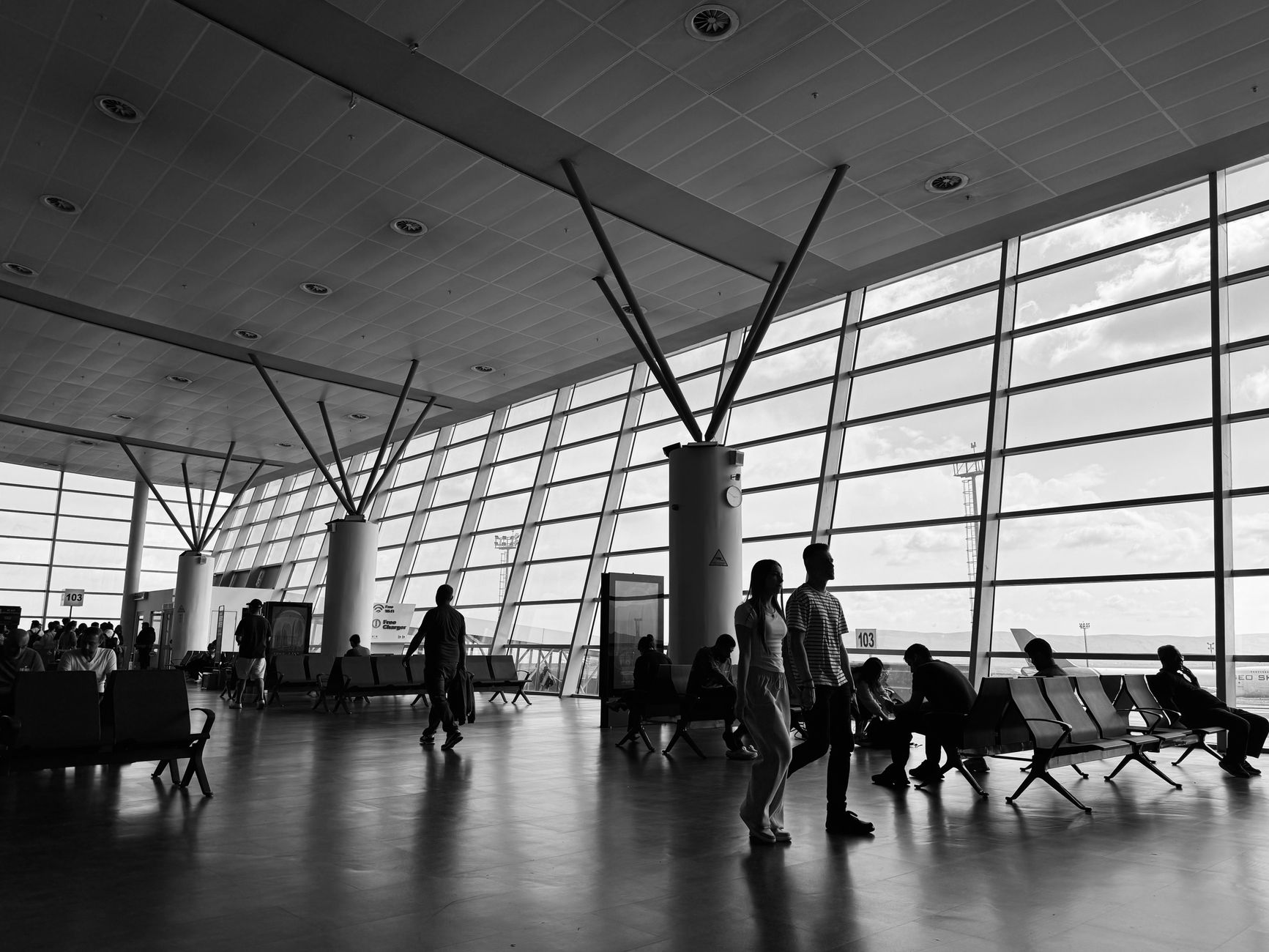
Arrival & Baggage
Arriving at BER Airport: One Level, Two Exits, Two Terminals
Arriving at Berlin BER in 2026: baggage reclaim on level E0, eight belts in Terminal 1 and three in Terminal 2, the station two levels down, the FEX to Hauptbahnhof in 23 minutes — and the meeting point almost everyone gets wrong.
Sophie Bauer17 September 2026